
Verification and validation
OpenFLUME is Alpha software. It was written by one engineer with heavy AI assistance (see "How This Was Built" in the README), so it has to be checked, not trusted. This page is the index to that evidence: what kind of evidence each result is, how the reports are produced, how often the checks run, and where the evidence stops.
The authoritative record is §8 of the user's manual. Before using a result to support a decision, read §1.7 Scope Boundaries as well.
Three classes of evidence
The manual (§8.1) separates three kinds of evidence. They mean different things, and a result should be cited with its class:
| Class | Compared against | What a disagreement means |
|---|---|---|
| Analytic verification | A closed-form solution, or an independent reference (e.g. RK4 integration of the exact ODE) converged far below the solver's own tolerance | A code defect, or discretization error that should shrink as the grid or time step is refined |
| Code-to-code benchmarking | Published output of another established program (NASA GFSSP, SINDA/FLUINT sample decks, COMSOL results in papers) | Supports the implementation, but inherits the other code's assumptions |
| Validation against experiment | Measured data, digitized with cited provenance | Could be the model, the closure correlation, the discretization, or the experiment |
Where a correlation has research status or has not been validated, the manual says so and gives no agreement figure for it (§8.5).
How the reports are generated
Each of the seven reports below is written by a script in scripts/, which builds the cases, runs the current solver, computes the reference solutions, and writes the Markdown and SVG figures. None of the numbers are typed in by hand.
| Report | Generator | CI gate tests named in the report |
|---|---|---|
| Compressible flow | scripts/compressible-validation-report.ts | src/core/__tests__/compressibleDuctFlow.test.ts |
| Incompressible hydraulics | scripts/hydraulics-validation-report.ts | solver.test.ts, benchmarks.test.ts |
| Thermal network | scripts/thermal-validation-report.ts | thermal.test.ts, solidThermalTransient.test.ts |
| Fluid transient | scripts/fluid-transient-validation-report.ts | fluidTransient.test.ts |
| Tank transient | scripts/tank-transient-validation-report.ts | transient.test.ts, benchmarks.test.ts |
| Combustion | scripts/combustion-validation-report.ts | reactingJunction.test.ts and the examples suite |
| Microfluidics | scripts/microfluidics-validation-report.ts | src/validation/__tests__/microfluidics.test.ts, plus rectChannel, capillaryChannel and flowScaledTolerance tests |
To regenerate a report from a clone:
npx tsx scripts/compressible-validation-report.tsThe scripts are run by hand. CI does not rewrite the reports. A report therefore shows the solver as it was when the report was last regenerated, while the gate tests named in its header recheck the same physics on every CI run.
CI cadence
From .github/workflows/ci.yml:
- Every pull request and every push to
main: lint, format check, the fast test tier (npm test), and a production build. Ascientific-validationjob runs every Vitest file (npm run test:all) and the fluid-catalogue drift check. - Push to
main, weekly schedule (Mondays 03:17 UTC), and manual dispatch: the samescientific-validationjob runs withRUN_SLOW=1, which turns on the expensive opt-in sweeps and convergence studies. On pull requests these slow blocks are skipped. - Python package: the wheel is built and the installed wheel is tested on Linux, macOS, and Windows.
- End-to-end: the Playwright suite runs in four shards against the production build.
The test tiers are described in §8.6 and testing-slow.md.
The seven reports
The headline figures below are copied from each report's abstract or summary table. Each report gives the definitions, normalizations, and excluded stations behind its figures. Read those before quoting a number.
| Report | Cases | Reference | Headline agreement |
|---|---|---|---|
| Compressible flow: recreation of the NASA GFSSP TFAWS-2007 study | 5 cases (Fanno, Rayleigh, combined, two nozzles), 7 grid configurations | RK4 of the generalized 1-D ODE, cross-checked with Fanno/Rayleigh closed forms | With central momentum faces: mass flow within 0.18 %, worst profile error 2.5 % (Rayleigh ΔP/P and ΔM/M). With the default upwind faces: mass flow 0.36–3.48 %, max ΔM/M 4.0 %. The original study reports 1.7–5 % for GFSSP |
| Incompressible hydraulics | 6 cases, 49 compared quantities | Closed forms (Hagen–Poiseuille, Darcy–Weisbach, hydrostatics) and independently converged references (Hardy-Cross network, pump operating point) | All 49 within 9.98e-10 %, which is the Newton tolerance (10⁻⁹). The friction closure and the reference are the same expression, so this verifies the network solve, not the friction law |
| Thermal network | 5 cases | Series resistance, radiation–convection balance, lumped capacitance, heated-pipe exponential, ε–NTU | Composite wall 6.9e-14 %. Lumped cooldown within 0.18 % of span at dt = τ/100 (error ratio 4.01 for a 4× step refinement). 20-segment heat exchanger: effectiveness within 2.62 %, outlets within 1.730 K. The error shrinks as segmentation is refined |
| Fluid transient | 4 cases | Exact tanh/hyperbolic rigid-column laws, RK4 gas-spring oscillator, polytropic law | Startup/decay within 0.05 % RMS at the refined step. Oscillator period within 0.2 % (linearized) and 0.1 % (RK4). Method-of-characteristics water hammer is explicitly out of scope |
| Tank transient | 5 cases (including a 4-level dt study) | RK4 of the lumped ODEs, choked blowdown closed form, equalization equilibrium, fill-heating limit | Every trace within 1.5 % at dt = 0.05 s. Mass conserved to 0.001 % or better. First-order convergence in dt confirmed |
| Combustion: CEA reacting junction and LOX/RP-1 thruster | 5 groups of checks | CEA identities, choked-flow/orifice closed forms, RK4 quasi-1-D nozzle ODE, exact wall-resistance network | Local nozzle profile error 3.16 % (subsonic) and 4.87 % (supersonic). Mass flow biased 3.01 % by the sonic cell. Wall temperatures 2.3e-13 K. Startup ramp vs. quasi-static reference 7.8e-5 % |
| Microfluidics | 5 closed-form cases (Part A) + 6 published networks (Part B) | Shah & London, Washburn, Jurin; papers' COMSOL values, design values and measurements | Duct friction constant 0.002 %. Serial diluter inlet pressure 85.1 Pa vs. 85.2 Pa (COMSOL). Capillaric valve pressures within 1.3 %. Siphon flow 2.87 µL/s at nominal diameter vs. 3.63 ± 0.07 µL/s measured. The measurement lies inside the ±27 % flow band set by the stated diameter uncertainty |
Most of these reports are analytic verification. The compressible report recreates a code-to-code study case for case, but its references are analytic. Part B of the microfluidics report mixes classes: COMSOL values are code-to-code, while the siphon, dilution-ratio, and bead-trap outcomes are compared with measurements.
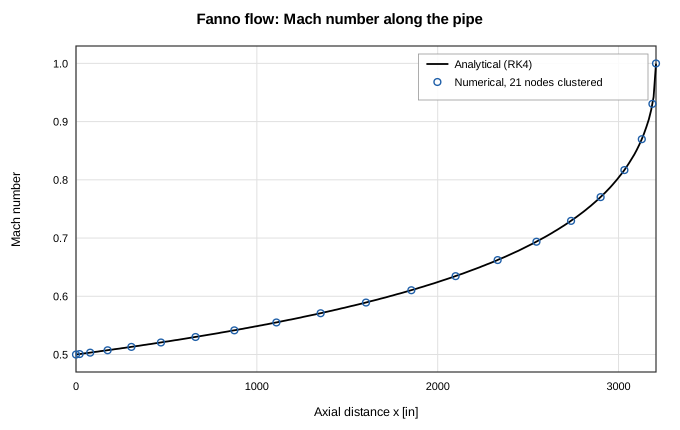
Fanno flow, Mach number along the duct, from the compressible-flow report.
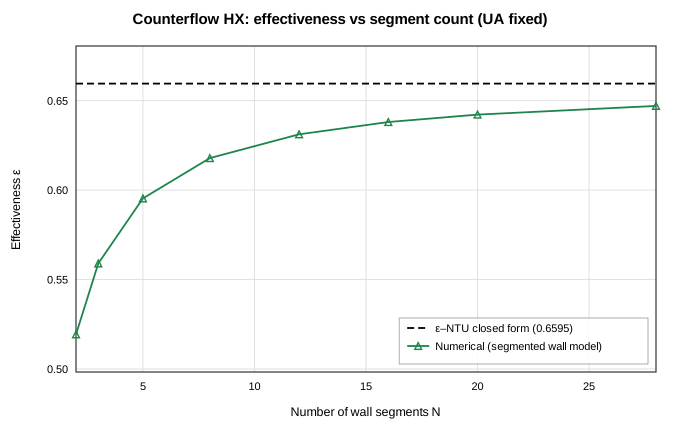
Counterflow heat-exchanger segmentation study, from the thermal-network report. The ε–NTU discrepancy shrinks as the wall is refined.
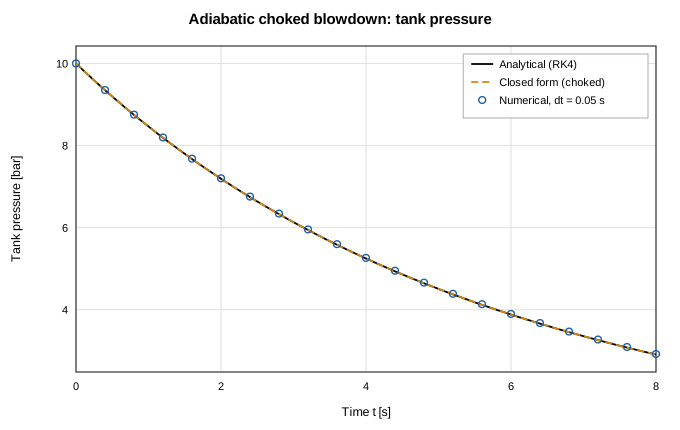
Choked adiabatic blowdown, tank pressure, from the tank-transient report.
Code-to-code benchmarks outside the reports
The manual's §8.3 lists further benchmarks, each gated by a test:
| Benchmark | Result (from §8.3) |
|---|---|
| GFSSP Example 13, conduction rod with convection | Solid temperatures within 3.0 K; conduction heat flows within 7 %; energy balance within 0.5 % |
| N₂–N₂ counterflow heat exchanger (JANNAF 2024, Majumdar & LeClair) | Duty within 5 %; outlets within 2.5 K |
| GFSSP Example 5, water-water heat exchanger | Hot outlet 295.67 ± 1.0 K; cold outlet 290.94 ± 0.5 K; duty within 3 % |
| Lee & Martin entrapped air (GFSSP Figure 10) | First peak within 15 %; trace within 8 % of an RK4 rigid column at refined step |
| SINDA/FLUINT Sample Problem F, LH₂ no-vent fill | Fill fraction, pressure, vapor temperature, and vent flow within about 1 % at 15 min |
| NURETH-16 gas-cooled reactor loop | Published trends only; geometry is representative |
See OpenFLUME vs. GFSSP and OpenFLUME vs. SINDA/FLUINT for what these benchmarks do and do not show.
Experimental corpora and trust levels
From §8.4:
- NBS Report 9264 cryogenic chilldown (Brennan et al., 1966). Table 6 provides eighteen chilldown-time points for saturated and subcooled LH₂ and LN₂. Eleven digitized oscillograph figures provide forty-four station traces (10 195 samples), rebuilt from source CSVs by
npm run gen:trace-corpus.- Trusted, calibration-grade: four saturated runs (sixteen traces).
- Diagnostic only: seven subcooled runs. At coarse axial discretization their errors reach +80 %. They may be used to diagnose a problem but may not be quoted as agreement.
- CI baseline: computed chilldown time at the instrumented station must stay within a factor of 1.6 of experiment, with mean absolute error under 25 % across the four-case slow suite. Two-phase chilldown energy and enthalpy balances close within 10 % and 12 %.
- Single-phase chilldown surrogates match the plateau-then-plunge shape only. They are not comparable on absolute times and are asserted as trends.
A factor-of-1.6 band is a regression guard, not a precision claim. Cryogenic chilldown is the least mature area of the code.
The repository also carries digitized datasets under validation/data/digitized/: Hord's cavitation series and other choked-flow data, NASA tank-pressurization tests, additional chilldown studies, and two-phase boiling pressure-drop data. The manual quotes agreement figures only for the NBS 9264 corpus. Treat the other datasets as available reference data, not as validation claims.
Correlation status
Closure correlations are where network codes most often go wrong. §8.5 records the status of each one. Swamee–Jain and Dittus–Boelter are standard. Miropolskii film boiling is used as GFSSP uses it for chilldown. Darr–Hartwig is verified structurally against its published equations, inside an LH₂ / vertical-upflow / 1 g envelope. TT-WF is research status, not validated. A custom expression is the user's responsibility.
Result provenance
Every run hashes the configuration that produced it. If the model is edited after a run, that result is marked stale. Exports and sweep CSVs carry the model name, a solver-settings summary, and the config hash (§8.7).
Reporting a disagreement
If OpenFLUME disagrees with a reference you trust, open an issue. The project treats a well-documented disagreement as one of the most useful contributions it can receive. The bug-report template asks for:
- the reference value and its source (analytical, published benchmark, or experiment);
- the tolerance you consider acceptable;
- units and assumptions;
- the model, as an attached
.fnfile or a pasted JSON config.
New validation cases are welcome too. See CONTRIBUTING.md. Numerical claims must state their reference, tolerance, and units. Do not relax tolerances without physical or numerical justification. Do not submit export-controlled material.