
OpenFLUME: an open-source alternative to NASA GFSSP
OpenFLUME is a GFSSP-style network solver you can open in a browser, read, script, and share. It reproduces several published GFSSP results; for work that needs GFSSP's features or heritage, GFSSP remains the right tool.
OpenFLUME is not affiliated with or endorsed by NASA. It is Alpha software (version 0.3.1) with none of GFSSP's program heritage.
About GFSSP
The Generalized Fluid System Simulation Program (GFSSP) is a general-purpose fluid network code developed at NASA Marshall Space Flight Center. It is distributed through NASA's software release process, which sets eligibility and terms; check the NASA software catalog for the current version and availability. GFSSP models a system as nodes and branches and solves coupled mass, momentum, and energy conservation with conjugate heat transfer. NASA has used it for propulsion feed systems, pressurization, cryogenic transfer-line chilldown, and thermal management, and its formulation and verification are documented in NASA technical memoranda and conference papers. OpenFLUME's user manual cites the Version 6.0 TM (NASA/TM-2013-217492) and the TFAWS-2007 compressible-flow paper (NTRS 20070036728) among others (Appendix E of the user's manual).
How OpenFLUME follows the GFSSP formulation
- Node/branch finite volume. Nodes are control volumes that store mass and energy. Each branch carries one mass-flow unknown, governed by a momentum relation between the endpoint pressures (§1.2). Volume and flow are staggered, as in GFSSP.
- Simultaneous Newton–Raphson solution of mass and momentum, with nodal enthalpy added to the coupled system for real fluids and compressible duct flow. As the solver source notes, solving the conservation equations simultaneously, as GFSSP does, keeps the system stable near choking (§4.6.1).
- Upwinded enthalpy in the energy equation, with internal-energy storage in transients (§4.1.3).
- Opt-in compressible terms. A convective-acceleration (momentum-flux) term and stagnation-enthalpy transport give quasi-1-D compressible duct flow. The default
momentumFluxScheme: "upwind"uses GFSSP-style donor-cell momentum advection with a limited face density (§4.1.2). - Lumped fluid inertia and trapped-gas cushions for rigid-column surge, the mechanism behind GFSSP's entrapped-air example.
- Miropolskii film boiling for chilldown, the correlation GFSSP uses (§8.5).
OpenFLUME does not read GFSSP input files, and its closure details, solver globalization (trust-region dogleg, pseudo-transient continuation), and component set differ. Expect GFSSP-class answers on the benchmark cases below, not identical ones.
GFSSP results reproduced
Compressible duct flow: the TFAWS-2007 study, case for case
The compressible-flow report recreates Bandyopadhyay & Majumdar, "Modeling of Compressible Flow with Friction and Heat Transfer using GFSSP" (TFAWS 2007): five cases, sixteen figures. The references are RK4 integrations of the generalized 1-D compressible-flow ODE, cross-checked against Fanno and Rayleigh closed forms.
| Case | ṁ error, default upwind | max ΔM/M, default upwind | ṁ error, central |
|---|---|---|---|
| 1 — Fanno (21 clustered) | 2.05 % | 2.2 % | 0.01 % |
| 2 — Rayleigh (21 clustered) | 3.48 % | 4.0 % | 0.00 % |
| 3 — Combined (21 clustered) | 2.19 % | 2.6 % | 0.18 % |
| 4 — Nozzle, friction (65 clustered) | 0.38 % | 0.6 % | 0.03 % |
| 5 — Nozzle, friction + heat (65 clustered) | 0.36 % | 0.6 % | 0.01 % |
The original study gives 1.7–5 % for GFSSP's own first-order upwind discretization. As in that study, the last station before a choked exit is excluded from the profile statistics; the error is largest at the choking cell. Shock capture remains out of scope.
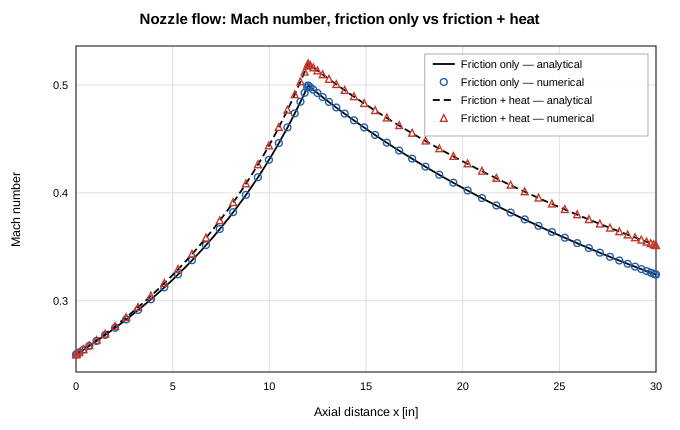
Mach number along the TFAWS-2007 nozzle, from the compressible-flow report.
GFSSP example problems
src/ui/tests/gfssp-benchmarks.test.ts gates three conjugate cases built in src/ui/examples.ts; src/ui/tests/leeMartin.test.ts gates the entrapped-air case. Tolerances are the test tolerances (manual §8.3):
| Benchmark | Source | What is checked |
|---|---|---|
| GFSSP Example 13, conduction rod with convection | NASA/TM-2011-216470 §6.13 | Solid temperatures within 3.0 K of analytical; end conduction heat flows within 7 %; global energy balance within 0.5 %; transient end state matches a steady solve within 0.5 % |
| GFSSP-style N₂–N₂ counterflow HX | Majumdar & LeClair, JANNAF 2024 | Duty within 5 % of ε–NTU; outlets within 2.5 K; hot/cold duty balance within 1 % |
| GFSSP Example 5, water-water counterflow HX | GFSSP v5 manual | Hot outlet 295.67 ± 1.0 K; cold outlet 290.94 ± 0.5 K; duty ≈ 25.6 kW within 3 %; outlets move toward the published values as segments go 4 → 8 → 12 |
| Lee & Martin entrapped air (GFSSP Figure 10) | GFSSP manual; independent RK4 rigid column | First peak within 15 %; trace within 8 % of RK4 at a refined step |
At the shipped twelve-pass discretization, Example 5 outlets are within 0.44 K (hot) and 0.19 K (cold) of the published GFSSP values (§7.9).
NBS cryogenic chilldown
The chilldown dataset (src/validation/nbsChilldown.ts) takes NBS Report 9264 test data from Table 6 of the GFSSP Version 6 paper (AIAA 2015-3850), which tabulates both measured and GFSSP-predicted chilldown times. OpenFLUME's CI baseline is loose: chilldown time within a factor of 1.6 of experiment, with mean absolute error under 25 % over the four-case slow suite (§8.4). That is well short of GFSSP-equivalent chilldown accuracy.
When to use which
Use GFSSP when:
- you have access to it and your organization's processes already rely on its heritage;
- you need features OpenFLUME lacks (see limitations below), or a code with NASA program history behind it;
- you need to reproduce or extend an existing GFSSP model exactly.
Consider OpenFLUME when:
- you cannot get GFSSP, or need something running in minutes without installation;
- you want to read and audit the solver, closures, and tests (MIT license);
- you want to script studies from Python (
pip install openflume) or keep models as plain-text.fnfiles under version control; - you are teaching or reviewing a model;
- you want an independent cross-check of a GFSSP result.
For important work, use OpenFLUME for early sizing and as an independent second solver, and the qualified tool your program requires for results of record.
Migrating a model
Coming from GFSSP maps GFSSP concepts to OpenFLUME's interface and file format. In brief: OpenFLUME models are SI throughout, positive mass flow follows the declared from → to direction, and every network needs at least one boundary node (§1.4).
Limitations relative to GFSSP
From §1.7 Scope Boundaries:
- No shock capture. Quasi-1-D choking and seeded supersonic nozzles only. No thrust calculation.
- No acoustic wave propagation / MOC water hammer. Lumped inertia only.
- Two-phase is HEM only. No Lockhart–Martinelli yet.
- Cavitation only at the cavitating-venturi closure.
- Turbomachinery is a pump curve. No compressor or turbine maps.
- No general junction mixing of unlike fluids outside CEA reacting junctions.
- Smaller, younger component library (19 branch types plus user JavaScript components). User code is trusted, not sandboxed.
- Steady closed ideal-gas loops need a pressure anchor.
- Alpha, single author, heavy AI assistance, no flight or program qualification. Check results against the verification record.
Example links
These open a running model in the app:
- Water-water counterflow heat exchanger (GFSSP Example 5)
- Entrapped-air line (Lee & Martin, GFSSP Figure 10)
- Cryogenic line cooldown (NBS Report 9264, Figure 2)
- Tank blowdown (transient ideal-gas tank through an orifice)
- Sanity: orifice hand-calc (closed-form check)