
OpenFLUME: an open-source alternative to SINDA/FLUINT
OpenFLUME is an open-source thermal and fluid network solver that overlaps with SINDA/FLUINT, reproduces some of its sample results, and falls short of it in several specific areas listed below.
OpenFLUME is not affiliated with C&R Technologies. It is Alpha software (version 0.3.1).
About SINDA/FLUINT
SINDA/FLUINT is a commercial thermal and fluid network analyzer developed and sold by C&R Technologies. SINDA is the lumped-parameter thermal network solver (conduction, convection, radiation between thermal nodes); FLUINT is the coupled fluid network solver (lumps, paths, tanks, junctions, and two-phase flow). Its lineage goes back to NASA-era thermal analyzer codes, and it has a long record in spacecraft and aerospace thermal-control and cryogenic analysis. C&R also sells Thermal Desktop, a CAD-based front end. Check C&R for licensing, current features, and support.
Where the two overlap
Like SINDA/FLUINT, OpenFLUME carries two coupled networks:
| Concept | SINDA/FLUINT (general) | OpenFLUME |
|---|---|---|
| Thermal node | Diffusion, arithmetic, and boundary nodes | Solid node (lumped mass × specific heat) and ambient node (fixed-temperature reservoir). Transient solid nodes need positive mass, so capacitance-free arithmetic nodes are not available |
| Thermal conductor | Linear and radiation conductors | Conduction, convection, radiation conductors (Appendix B) |
| Fluid control volume | Lumps (tanks, junctions, plena) | Internal and boundary fluid nodes, with optional volume for transients |
| Flow path | Paths (tubes, connectors) | Branches with one of 19 component types |
| Fluid–wall coupling | Ties | Convection conductors between a fluid node and a solid or ambient node, using Dittus–Boelter, Miropolskii, Darr–Hartwig, a specified h, or an expression |
| Temperature-dependent solids | User arrays and properties | A sourced material catalogue with validity ranges (solid properties) |
| User logic | User-written logic blocks | Registers, declarative logic rules, stop rules, PID controllers, and JavaScript user components (user code) |
| Real fluids | Fluid property descriptions | CoolProp (124-fluid HEOS catalogue), compiled to WebAssembly |
SINDA/FLUINT cases reproduced
Sample Problem F: LH₂ tank no-vent fill
The LH₂ tank no-vent fill example reproduces the transient no-vent fill in SINDA/FLUINT Sample Problem F (model TVS). A half-full, saturated 42-inch LH₂ tank is filled from a colder 60 psia source while a thermodynamic vent system bleeds liquid. At 15 minutes, against the deck's Figure F-4 / user-file table (from the module header of src/ui/lh2StorageTank.ts and manual §7.13):
| Quantity | OpenFLUME | Deck |
|---|---|---|
| Fill fraction | 0.734 | 0.739 |
| Tank pressure | 59.63 psia | 59.72 psia |
| Vapor temperature | 47.78 R | 47.387 R |
| Liquid temperature | 38.99 R | 38.098 R |
| TVS flow | 0.0518 lbm/hr | 0.0522 lbm/hr |
src/ui/tests/lh2StorageTank.test.ts gates these values, and also checks that the tank volume constraint holds to 1e-9 and that tank pressure rises toward the source instead of collapsing.
FLUINT's twinned tanks and moveable ties have no direct equivalent in OpenFLUME's schema, so the example emulates them with registers, logic rules, and register controllers. The module header lists what is emulated and what departs from the deck: CoolProp parahydrogen replaces the deck's fluid description, the fill source is 14.0 K instead of the deck's 20 R, and the deck's steady TVS-sizing case is not reproduced.
The vapor-cooled shield and internal heat exchanger are carried as solid thermal mass but are not resolved as flow paths. Their ducts run at NTU ≈ 29 per node, and at that NTU OpenFLUME's segregated solid–fluid coupling loop does not converge. The source calls this a hard limitation of the solver: strongly coupled, high-NTU wall–fluid problems are a known weak point.
Cryogenic line cooldown (NBS Report 9264)
The cryogenic line cooldown example is the C&R Technologies validation case drawn from NBS Report 9264, Figure 2. Saturated LH₂ at 75 psia enters a 61 m copper line, initially at 300 K, modeled as twenty axial segments with temperature-dependent copper specific heat and Miropolskii film boiling (§7.11). Agreement with experiment is modest: the CI baseline holds chilldown time within a factor of 1.6 of experiment, with mean absolute error under 25 % across the slow suite. Only saturated runs are trusted; subcooled runs are diagnostic only (§8.4).
Thermal network verification
The thermal-network report verifies the solid-node system and its fluid coupling against analytic solutions. The composite wall matches to 6.9e-14 % and radiation equilibrium to 1.2e-14 %. Lumped cooldown is within 0.18 % of the temperature span at dt = τ/100, with first-order time convergence (error ratio 4.01 for a 4× step refinement). A 20-segment counterflow heat exchanger has effectiveness within 2.62 % and outlets within 1.730 K of ε–NTU; the remaining error is shown to be segmentation error.
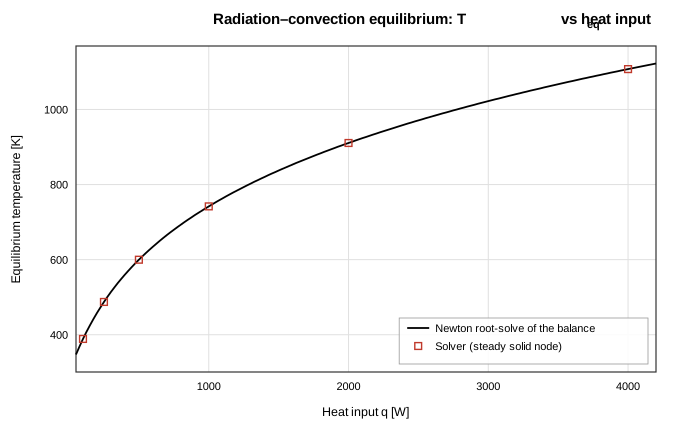
Radiation–convection equilibrium, from the thermal-network report.
When to use which
Use SINDA/FLUINT (or your program's qualified thermal tool) when:
- results go into a design of record, a flight thermal model, or a qualification argument;
- the model is large and thermally dominated: geometric radiation exchange, many thousands of thermal nodes, CAD-derived geometry;
- you need strongly coupled, high-NTU wall–fluid paths, capacitance-free arithmetic nodes, or FLUINT features such as twinned tanks that OpenFLUME can only emulate;
- you need separated-flow two-phase models or commercial support.
Consider OpenFLUME when:
- you need a fluid-plus-lumped-thermal network for early sizing, a trade study, or a sanity check, and have no license available;
- you want to read every equation and closure, and the tests behind them (MIT license);
- you want to drive studies from Python (
pip install openflume) or keep models in plain-text.fnfiles; - you are teaching heat transfer or thermal-fluid systems and want students to open a model from a link with nothing to install;
- you want an independent cross-check of a result from another tool.
Limitations
From §1.7 Scope Boundaries, plus the thermal-specific points above:
- Alpha, single author, heavy AI assistance, no flight heritage, no commercial support.
- Segregated solid–fluid coupling does not converge at very high NTU per node (see Sample F above).
- No view-factor computation. Each radiation conductor takes a user-supplied emissivity, area, and view factor. There is no geometry, CAD, or ray-tracing front end.
- Two-phase is HEM only. No Lockhart–Martinelli yet. Cavitation is modeled only at the cavitating-venturi closure.
- Turbomachinery is a pump curve. In the ammonia loop heat pipe radiator example, wick capillary pumping is represented by a fixed pump curve (§7.6).
- No acoustic waves, no shock capture.
- User code is trusted, not sandboxed.
Example links
- LH₂ tank no-vent fill (SINDA/FLUINT Sample Problem F)
- Cryogenic line cooldown (NBS 9264 Figure 2)
- Spacecraft radiator panel (ammonia loop heat pipe)
- Heated pipe with radiating wall (conjugate HT), the recommended first conjugate model
- Extension: Cryo tank vent control (transient), which shows registers, logic rules, and hysteresis